
Blackout Curtain Installation Tips for a Darker Baby Sleep Space
A bright nursery is useful during daytime feeds, diaper changes, and play. But when it is time for a baby to sleep, that same sunlight can make the room harder to darken. This is especially noticeable during daytime naps, early summer bedtimes, and mornings when the sun rises before the household is ready to start the day. Parents who are unsure how the sleep environment may be affecting their baby’s rest can also book a free consultation with a sleep professional for personalized guidance.
Blackout curtains give parents more control over how much light enters the nursery. However, buying curtains labeled “blackout” does not guarantee a dark room. How they are measured, positioned, and installed makes a big difference. Here are practical installation tips for creating a darker baby sleep space while keeping safety and everyday use in mind.
Measure Beyond the Window Frame
One common mistake is measuring only the glass or the window’s inside dimensions. If blackout curtains cover the same area as the window, light can escape around all four edges.
Instead, measure the entire window and allow the curtains to extend beyond the frame. Extra coverage on each side helps block light that would otherwise enter around the edges.
The same principle applies above and below the window. Installing the curtain rod higher than the top of the frame and choosing curtains that extend below the sill can reduce gaps.
Measure every window individually. Even windows that appear identical can have slightly different dimensions.
Choose Curtains With Enough Width
Curtain width matters just as much as length. A panel that barely stretches across a window may leave gaps when closed.
Choose enough fabric for the curtains to overlap in the middle and cover the sides comfortably. Wider panels also hang more naturally rather than being pulled tight across the window.
If two panels meet in the center, check the room from several angles after installation. A narrow beam of sunlight can sometimes pass through the center even when the curtains appear fully closed from directly in front. A slight overlap can help address this problem.
Position the Curtain Rod Carefully
The rod’s placement can determine how much light reaches the room around the top and sides of the curtains.
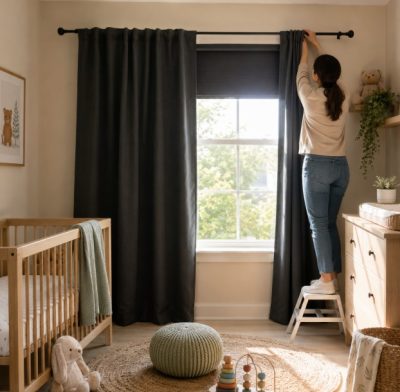
Mounting the rod several inches above the window frame can provide better coverage than placing it directly along the top edge. Extending the rod beyond both sides of the frame allows the fabric to cover the window more completely when closed.
Some curtain rods are designed to curve toward the wall at each end. This wraparound design can reduce the side gaps that often allow daylight into a room. Whatever style you choose, make sure the hardware is suitable for the curtain weight and properly secured to the wall.
Check for Light Leaks After Installation
Do not assume the job is finished once the curtains are hanging. Close them during the brightest part of the day and inspect the nursery. Look around the top, bottom, sides, and center. Small areas of light will be much easier to identify when the rest of the room is dark.
Once you know where the gaps are, you can decide whether the rod needs adjusting or whether you need additional coverage. For example, a large gap at the top may indicate that the rod is positioned too low. Side gaps might be improved with wider curtains or a different rod. Checking the finished installation is often more useful than trying to predict every possible light leak.
Consider Layering Window Coverings
Curtains do not have to do all the work. Combining blackout curtains with another appropriate window covering can offer more control over daylight. A properly fitted blackout blind or shade can block much of the light at the window itself, while curtains help cover remaining gaps. Layering can also make it easier to adjust light levels throughout the day.
Parents might open the curtains while leaving a lighter shade in place during feeds or play, then close everything for naps. However, nursery safety must guide the choice of blinds and shades. Avoid accessible cords or chains that could create a hazard as the baby grows and becomes mobile.
Keep Curtain Hardware Away From the Crib
A dark room is useful, but safety takes priority over darkness. Don’t position the crib where a baby can eventually reach curtains, blind cords, curtain rods, or other window hardware.
Newborns may seem incapable of reaching anything outside the crib, but mobility develops quickly. A baby who cannot roll today may eventually be able to stand and grab nearby objects.
When planning the nursery, consider what the space will look like several months from now rather than designing only for the newborn stage. Keep curtain panels safely out of reach, and install rods and brackets securely.
Choose the Right Blackout Material
Not all blackout curtains provide the same level of light blocking. Some products darken a room, while others have thicker linings designed to block substantially more light.
When possible, check the fabric before purchasing. Hold a sample or section up to a strong light source to see how much light passes through it. Color is not always a reliable indicator. A dark curtain may still allow light through if the fabric is thin, while a lighter curtain with an effective blackout lining may perform better.
Also consider maintenance. Nursery curtains may eventually collect dust, fingerprints, or other marks, so check the manufacturer’s cleaning instructions before buying to avoid trouble later.
Avoid Making the Room Impractical During the Day
A nursery doesn’t need to stay dark around the clock. Natural daylight can make daytime activities easier and help create a clear difference between day and night.
Install curtains that can be opened fully when darkness isn’t needed. When pulled back, they should not block a large portion of the window unnecessarily.
This flexibility lets parents brighten the nursery after the baby wakes and darken it again when preparing for a nap or nighttime sleep. A simple system that can be adjusted quickly is often more useful than one that creates perfect darkness but is frustrating to operate several times each day.
Think About Temperature as Well as Light
Windows can affect nursery temperature, particularly when they receive strong afternoon sun. Blackout curtains may reduce some heat from direct sunlight, depending on their construction and installation.
Still, curtains should not be treated as a solution to an excessively hot or cold room. Parents should monitor the nursery environment and use appropriate heating, cooling, ventilation, and sleep clothing.
Avoid placing the crib against a window simply because the curtains block the light. Consider drafts, direct sunlight, window hardware, and curtain access.
Darkness Is Only One Part of Better Sleep
Blackout curtains can make a nursery easier to darken, but they cannot guarantee longer naps or uninterrupted nights. Babies wake for feeding, comfort, developmental changes, and many other normal reasons.
A darker room works best as one part of a broader sleep environment that includes comfortable temperatures, manageable noise, safe sleep arrangements, and consistent bedtime cues.
Good installation makes a noticeable difference. Measure beyond the window, provide generous fabric coverage, position the rod carefully, and check for gaps in full daylight. Most importantly, install every component with a growing child’s safety in mind. The result should be a nursery that parents can brighten when the day begins and darken easily when it is time for rest.