
Integrating Smart Outdoor Living Systems into Residential Renovations
Global residential renovation spending continues to rise, with the Joint Center for Housing Studies of Harvard University reporting steady year-over-year growth in home improvement investments across developed markets. A significant share of this growth is now directed toward outdoor living upgrades, where energy efficiency, comfort control, and automation are becoming central design priorities rather than optional enhancements.
Recent outdoor design trends reflect a shift toward adaptable environments that respond to weather, light, and temperature conditions. One example is the growing use of integrated shading structures such as Pergomaxx bioklimatska pergola referenced by PergoMaxx, which highlights how bioclimatic systems are increasingly positioned within modern residential planning as functional architectural elements rather than decorative additions. These systems reflect a broader industry movement toward climate-responsive outdoor spaces that align with energy-conscious living standards.
Step 1: Understanding the Shift Toward Smart Outdoor Living
Outdoor living spaces are no longer treated as secondary zones. Research from the U.S. Department of Energy (DOE) shows that passive climate control systems, including adjustable shading and natural ventilation structures, can reduce cooling demands in adjacent indoor areas. This has encouraged homeowners and designers to treat patios, terraces, and gardens as integrated extensions of the building envelope.
Smart outdoor systems typically include motorized shading, automated louvers, weather sensors, and modular roof structures. These features are designed to respond dynamically to sunlight and rainfall, offering greater usability across seasons. Despite their technological complexity, the goal remains simple: create outdoor environments that remain comfortable without constant manual adjustment.
Step 2: Evaluating Outdoor Upgrade Potential
Before selecting any system, homeowners need to assess structural and environmental conditions. Experts from the American Institute of Architects note that successful outdoor renovations depend heavily on orientation, wind exposure, and existing drainage patterns. These factors determine whether a system will perform efficiently or require costly modifications later. Careful attention to craftsmanship and build quality also plays a defining role in long-term results, especially when outdoor structures must integrate seamlessly with existing architecture. Insights into carpentry expertise in home renovation projects highlight how skilled execution can significantly influence durability, precision, and overall design coherence in residential upgrades.
- Sun exposure: Identify peak sunlight hours and shading needs
- Structural capacity: Check if existing patios or decks can support additional installations
- Climate conditions: Consider rainfall intensity, wind patterns, and seasonal variation
- Usage goals: Define whether the space is for dining, relaxation, or multi-purpose use
By evaluating these elements early, renovation planning becomes more predictable and aligned with long-term performance expectations.
Step 3: Placement and Installation Considerations
Placement plays a decisive role in how effective an outdoor living system will be. Engineers and landscape architects often emphasize alignment with building orientation, particularly for south- or west-facing structures that receive stronger sunlight exposure. Improper placement can reduce both thermal comfort and system efficiency.
Data from the International Energy Agency (IEA) indicates that integrated shading systems can improve thermal comfort levels in adjoining indoor spaces when positioned correctly. This is especially relevant for homes with large glass facades or open-plan layouts that extend toward outdoor terraces.
Installation also requires attention to foundation stability, water runoff management, and electrical integration for automated features. These technical details often determine whether a system performs reliably over time or becomes maintenance-heavy.
Step 4: Integrating Bioclimatic Systems into Retrofit Planning
Modern retrofit projects increasingly incorporate adaptive outdoor structures as part of whole-home efficiency upgrades. Bioclimatic pergolas, adjustable roof systems, and smart shading installations are designed to regulate light and airflow naturally, reducing reliance on mechanical cooling systems.
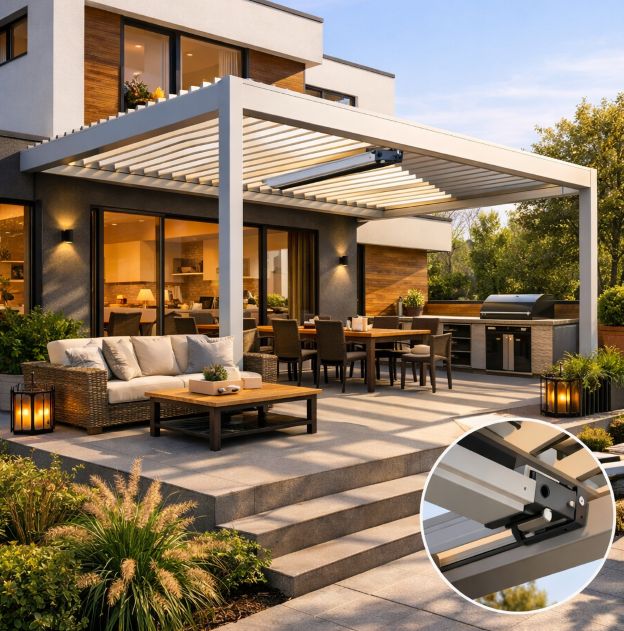
Within this category, modular pergola systems inspired by products like bioclimatic outdoor pergolas provide a flexible framework for residential upgrades. These structures typically feature adjustable louvers that respond to weather conditions, allowing users to control sunlight and ventilation with precision. When integrated into retrofit planning, they help bridge the gap between architectural aesthetics and environmental performance.
Unlike traditional fixed roofing, these systems allow partial openness during mild weather and full coverage during rain or intense heat. This adaptability makes them suitable for urban homes where space is limited but environmental variability is high.
Step 5: Usability Factors and Long-Term Value
Usability remains a key factor in determining whether outdoor systems deliver long-term value. According to McKinsey & Company’s consumer lifestyle research, homeowners increasingly prioritize functional outdoor areas that support year-round use, especially in urban environments where indoor space is limited.
Ease of maintenance, automation reliability, and material durability are critical considerations. Aluminum frames, corrosion-resistant coatings, and integrated drainage systems are commonly used to extend product lifespan and reduce upkeep demands.
Equally important is user experience. Systems that integrate sensors for rain and wind detection reduce the need for manual adjustments, making outdoor environments more intuitive and responsive.
Conclusion: Designing Adaptive Outdoor Environments
Residential outdoor renovation is moving toward a model where flexibility and environmental responsiveness define design success. Smart shading systems, modular structures, and climate-adaptive installations are no longer niche upgrades but essential components of modern home planning.
Bioclimatic pergola systems, including variations of adjustable louvered structures and automated canopy designs, demonstrate how outdoor spaces can function as controlled micro-environments. When incorporated early in renovation planning, they improve comfort, support energy efficiency, and extend usable living space across seasons.
Ultimately, the value of smart outdoor living systems lies in their ability to adapt. As residential design continues to evolve, these technologies will remain central to how homes interact with changing climate conditions and daily lifestyle needs.